Tungsten Alloy Balancing Block
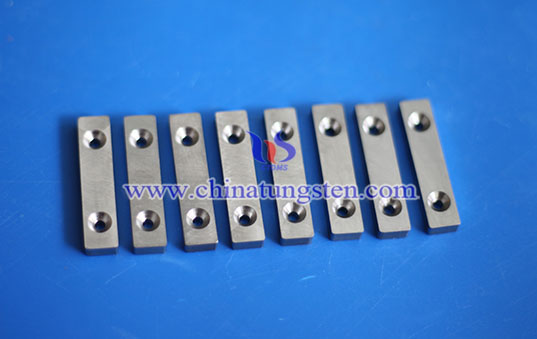
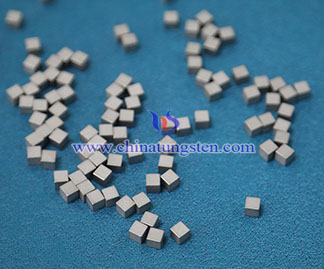
1. What's Tungsten Alloy Balancing Block?
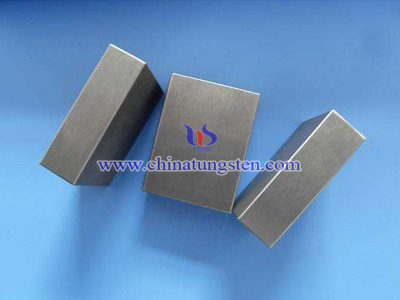
Tungsten alloy balancing block is counterweight component for balance correction, produced from tungsten heavy alloy for rotating or moving parts such as wheels, rotors, impellers and motors. By adding mass at specific positions, it corrects mass distribution and achieves the required static or dynamic balance. CTIA's tungsten alloy balancing block offers high density, providing the required mass in a compact volume for balancing structures with limited installation space.
2. Features of CTIA's Tungsten Alloy Balancing Block
(1) High Density and Small Volume: Density can reach 16.5–18.8 g/cm³. Under the same mass the volume is approximately 40%–47% that of steel and 60%–69% that of lead, suitable for balance correction within limited space.
(2) High Strength and Vibration Stability: Tensile strength typically reaches 700–1000 MPa with hardness of about 24–35 HRC, suitable for high-speed rotation, continuous vibration and similar operating conditions.
(3) Precise Mass and Flexible Correction: Single-piece weight of the balancing block can be controlled according to the unbalanced amount. Mass distribution is adjusted through dimensions, installation position and eccentricity, suitable for static and dynamic balance correction.
(4) Precision Machining and Diverse Structures: Supports turning, milling, drilling, grinding and CNC machining, with perforated, slotted, stepped and irregular structures available for different installation requirements.
(5) Dimensional Stability for Long-Term Operation: Linear expansion coefficient is relatively low, approximately 4.3–5.5×10⁻⁶/°C. Dimensional change under temperature variation is small, helping maintain stable balance position.
3. Applications of CTIA's Tungsten Alloy Balancing Block
(1) Automotive and Transportation: Used in wheels, brake discs, drive shafts and other rotating components to correct mass deviation and reduce imbalance during rotation.
(2) Motors and Rotors: Used in motor rotors, generator rotors and high-speed rotating assemblies to improve rotor mass distribution and reduce operational vibration.
(3) Industrial Machinery: Used in fan impellers, pump rotors, machine tool spindles and rotating platforms to meet balance correction needs under different speed conditions.
(4) Aerospace: Used in aero-engine rotating assemblies, gyroscopes and inertial motion components to complete fine mass compensation within limited space.
(5) Precision Equipment: Used in optical platforms, precision actuators, high-speed motion assemblies and testing equipment to meet small-volume, high-precision balance correction requirements.
4. Specifications of CTIA's Tungsten Alloy Balancing Block
(1) Materials: W-Ni-Fe or W-Ni-Cu tungsten alloy
(2) Tungsten Content: 90%–97%
(3) Density: 16.5–18.8 g/cm³
(4) Product Structures: Solid, perforated, slotted, stepped and irregular customized blocks.
(5) Dimensions: Customizable
(6) Surface Finish: Polished, customizable
With nearly 30 years of tungsten alloy manufacturing experience, CTIA GROUP (CTIA) offers mature powder metallurgy forming and precision machining capabilities. CTIA supplies tungsten alloy balancing blocks in various dimensions, weights and structures, customized to installation methods, balancing positions and machining precision for balance correction in automotive, motors, industrial machinery, aerospace and precision equipment.
For any inquiry, please contact tungsten alloy manufacturer: CTIA GROUP
Email: sales@chinatungsten.com
Tel: 0086 592 5129696 / 0086 592 5129595
Website: tungsten-alloy.com
WeChat:

Related Products: